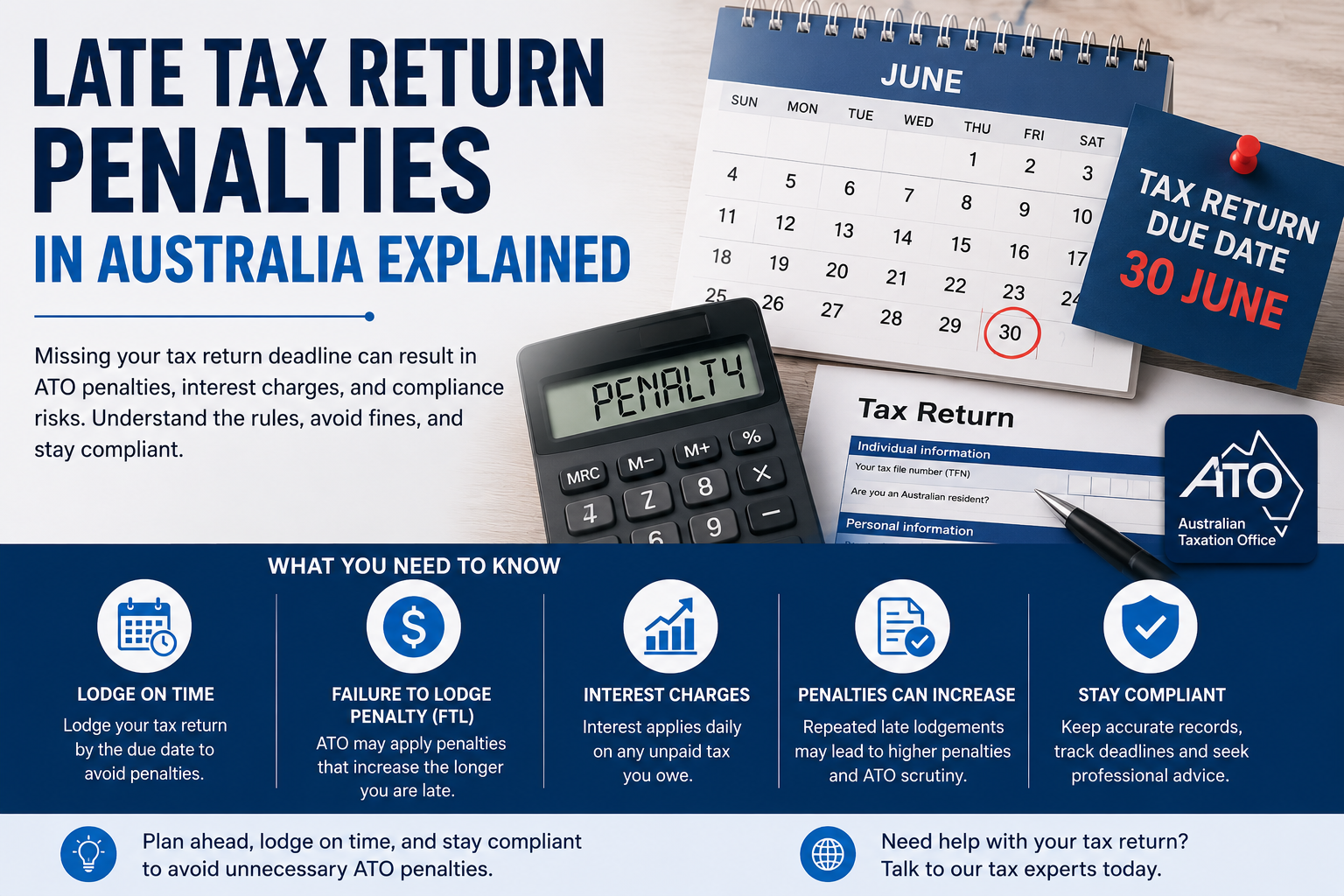
Late Tax Return Penalties in Australia Explained
Businesses and individuals in Australia are required to lodge tax returns within the deadlines set by the Australian Taxation Office (ATO). When tax returns are lodged late, penalties and interest charges may apply depending on the type of entity, the length of the delay, and the amount owed.
Many taxpayers assume late lodgement only results in a small fine. In reality, ongoing delays can trigger additional financial penalties, interest charges, compliance scrutiny, and potential audit attention from the ATO.
Understanding how late tax return penalties work can help businesses and individuals avoid unnecessary costs and maintain better tax compliance.
What Happens If a Tax Return Is Lodged Late?
When a tax return is not submitted by the required deadline, the ATO may apply a Failure to Lodge (FTL) penalty. The penalty amount generally increases based on how long the return remains overdue.
In some situations, the ATO may also apply interest charges if unpaid tax liabilities remain outstanding after the due date.
- Companies
- Sole traders
- Partnerships
- Trusts
- Individuals
- SMSFs
Common Reasons Businesses Lodge Tax Returns Late
Many late lodgements occur because businesses struggle with incomplete financial records or poor compliance management.
- Missing bookkeeping records
- Delayed financial statements
- Poor record management
- Cash flow difficulties
- Missed tax deadlines
- Unclear reporting obligations
Businesses that maintain structured financial reporting systems are generally better positioned to avoid compliance delays.
How ATO Failure to Lodge Penalties Work
The ATO calculates Failure to Lodge penalties using penalty units. The total penalty depends on:
| Factor | Impact on Penalty |
|---|---|
| Entity type | Different penalties may apply to individuals and companies |
| Length of delay | Penalties increase as delays continue |
| Compliance history | Repeated late lodgements may increase scrutiny |
| Outstanding liabilities | Interest charges may also apply |
Larger businesses may face higher penalties compared to individuals or smaller entities.
Interest Charges on Unpaid Tax
If tax liabilities remain unpaid after the due date, the ATO may apply General Interest Charges (GIC).
Interest continues accumulating until the outstanding balance is paid in full. Over time, this can significantly increase the total amount owed.
Can the ATO Reduce Tax Penalties?
In certain circumstances, the ATO may remit or reduce penalties.
This generally depends on:
- Serious illness
- Natural disasters
- Unexpected business disruptions
- Genuine mistakes
- Voluntary disclosures
Penalty remission is assessed individually and is not automatically approved.
How Businesses Avoid Late Tax Penalties
Maintaining organised financial records and structured reporting systems plays a major role in avoiding late lodgement issues.
- Maintain updated bookkeeping records
- Track tax deadlines
- Review financial statements regularly
- Prepare tax documents early
- Monitor ATO obligations throughout the year
Businesses requiring ongoing support with tax reporting often implement structured tax return and financial reporting services to maintain reporting accuracy and reduce compliance risks.
Why Accurate Financial Records Matter
Late tax lodgements are commonly linked to incomplete or inaccurate accounting records.
When bookkeeping is delayed or financial information is inconsistent, preparing tax returns becomes more difficult and time-consuming.
Businesses maintaining reliable accounting systems are generally able to manage year-end reporting more efficiently.
Many organisations also align financial reporting processes with broader business tax return deadline management to reduce compliance risks throughout the financial year.
Who Is Most at Risk of Late Lodgement Penalties?
- Growing businesses
- Companies with poor bookkeeping systems
- Businesses managing multiple entities
- High transaction-volume organisations
- Businesses without structured financial oversight
As reporting obligations become more complex, maintaining proactive tax compliance becomes increasingly important.
Key Takeaways
Late tax return penalties in Australia can increase quickly when lodgement deadlines are missed. Businesses may also face interest charges, compliance scrutiny, and ongoing administrative complications.
Maintaining accurate financial records, monitoring reporting deadlines, and implementing structured compliance systems are essential for reducing tax risks and avoiding unnecessary penalties.
Frequently Asked Questions
What is a Failure to Lodge penalty?
A Failure to Lodge penalty is a fine issued by the ATO when a required tax return or statement is not submitted by the due date.
Does the ATO charge interest on unpaid tax?
Yes. The ATO may apply General Interest Charges on unpaid tax liabilities until the outstanding balance is fully paid.
Can late tax penalties be reduced?
In some situations, the ATO may remit penalties due to exceptional circumstances, genuine mistakes, or voluntary disclosures.
How can businesses avoid late tax return penalties?
Businesses can reduce risks by maintaining accurate bookkeeping records, tracking deadlines, and preparing tax documentation early.
Do small businesses receive tax penalties?
Yes. Small businesses may still receive penalties for late lodgements depending on the entity type and delay period.
Can repeated late lodgements trigger ATO reviews?
Yes. Ongoing compliance failures may increase the likelihood of additional ATO scrutiny or reviews.