EOFY Checklist for Accountants
The End of Financial Year (EOFY) is one of the busiest periods for Australian accounting firms. Between reviewing financial records, lodging tax obligations, reconciling accounts, and advising clients, even small oversights can lead to compliance issues or unnecessary delays.
Having a structured EOFY checklist helps accountants streamline their workflow, minimise errors, and ensure every client receives accurate and timely financial support.
Whether you manage individuals, small businesses, trusts, companies, or self-managed super funds (SMSFs), this guide provides a practical checklist to help you prepare for the EOFY efficiently.
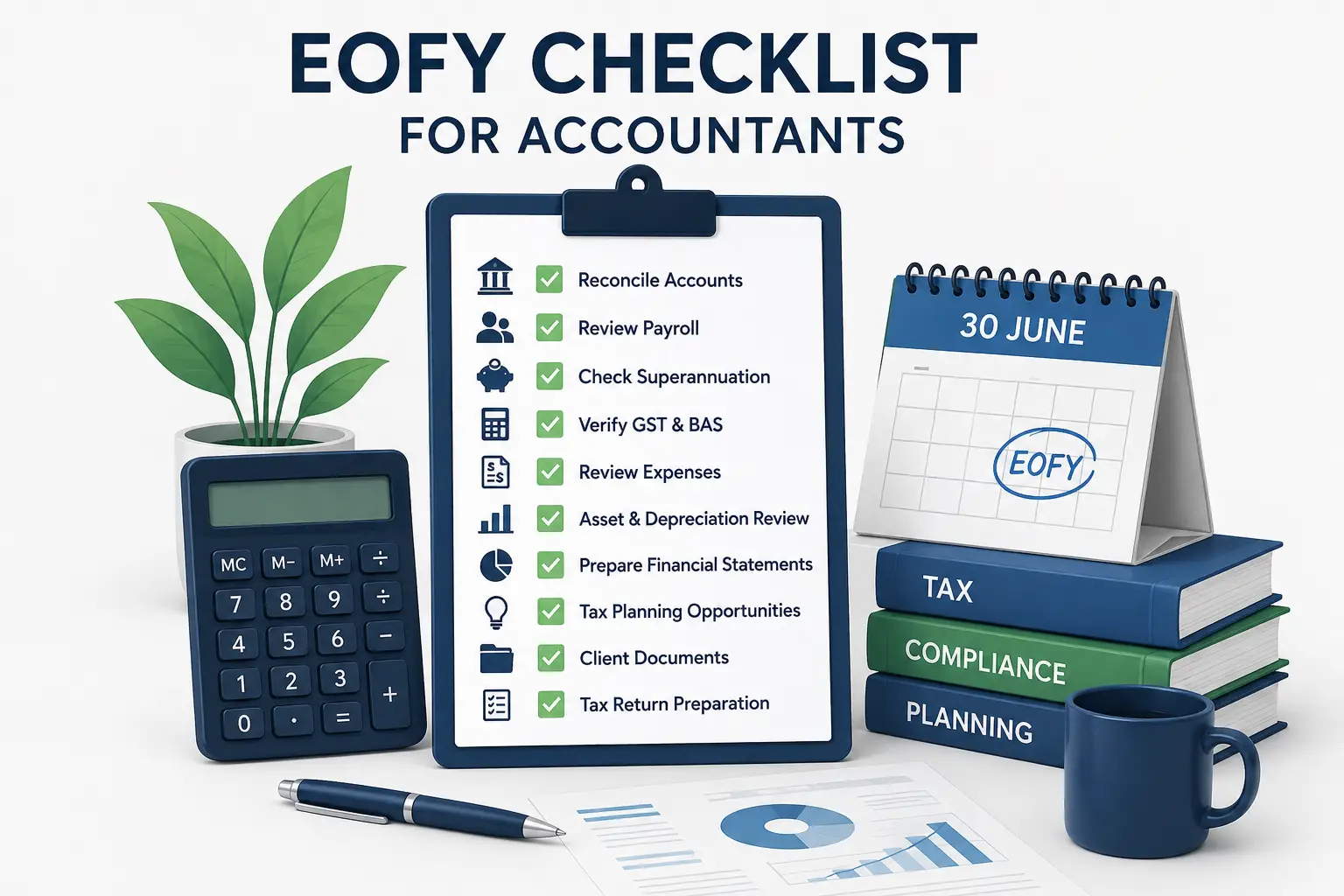
Quick EOFY Checklist Summary
| Task | Why It Matters | Priority |
| Reconcile bank accounts | Ensure accurate financial records | High |
| Review payroll and STP | Confirm payroll compliance | High |
| Verify GST and BAS records | Avoid reporting discrepancies | High |
| Prepare financial statements | Support tax return preparation | High |
| Review deductible expenses | Maximise legitimate tax deductions | High |
| Check asset purchases and depreciation | Calculate accurate depreciation claims | Medium |
| Review superannuation contributions | Ensure compliance and eligibility | High |
| Verify client documentation | Reduce delays during lodgement | High |
| Complete tax planning reviews | Identify opportunities before deadlines | Medium |
| Archive financial records | Meet record-keeping obligations | Medium |
Why an EOFY Checklist Matters
EOFY is more than preparing tax returns. It is an opportunity to review financial accuracy, identify tax planning opportunities, strengthen compliance, and help clients start the new financial year with organised records.
Benefits of following a structured checklist include:
- Reduces compliance risks
- Improves workflow efficiency
- Minimises last-minute corrections
- Supports accurate financial reporting
- Creates a better client experience
- Helps accounting teams manage higher workloads
1. Reconcile All Financial Accounts
Start by reconciling every financial account.
This includes:
- Business bank accounts
- Credit cards
- Loan accounts
- Merchant facilities
- Payment gateways
- Petty cash
Any unreconciled transactions should be investigated before preparing year-end reports.
2. Review Payroll Records
Payroll errors are among the most common EOFY issues.
Review:
- Employee wages
- PAYG withholding
- Leave balances
- Bonuses
- Termination payments
- Single Touch Payroll (STP) submissions
Ensure payroll reports match accounting records before finalisation.
3. Confirm Superannuation Contributions
Check whether:
- Employer super contributions have been paid
- Contributions were received before the required deadlines
- Contribution caps have not been exceeded
- Payroll reports match super payment records
Superannuation timing can significantly affect tax deductions.
4. Review GST and BAS Information
Compare GST collected against:
- Sales records
- Purchase records
- BAS submissions
- Accounting software reports
Any inconsistencies should be resolved before lodging year-end tax returns.
For the latest EOFY obligations and compliance guidance, refer to the Australian Taxation Office’s EOFY resources.
5. Verify Business Expenses
Review expenses to ensure they are:
- Correctly categorised
- Supported by invoices
- Business-related
- Eligible for tax deductions
Pay special attention to:
- Travel
- Motor vehicle expenses
- Home office expenses
- Professional subscriptions
- Insurance
- Software licences
6. Review Fixed Assets and Depreciation
Check whether clients have:
- Purchased new equipment
- Sold business assets
- Disposed of obsolete assets
- Acquired vehicles
- Purchased office technology
Update the depreciation schedule accordingly.
7. Review Client Documentation
Request any missing information before tax preparation begins.
Examples include:
- Bank statements
- Loan statements
- Investment income
- Dividend statements
- Rental property records
- Capital gains information
- Trust distribution statements
Collecting documents early reduces processing delays.
8. Prepare Financial Statements
Prepare and review:
- Profit and Loss Statement
- Balance Sheet
- Cash Flow Statement
- Trial Balance
- General Ledger
Ensure every figure agrees with supporting documentation.
9. Identify Tax Planning Opportunities
EOFY is an ideal time to identify legitimate tax planning strategies.
Review:
- Timing of income
- Deductible purchases
- Capital expenditure
- Super contributions
- Asset write-offs
- Trust distributions
Every client’s circumstances should be assessed individually.
10. Prepare for Tax Return Lodgement
Before lodging returns, confirm:
- Client details are accurate
- ABN information is correct
- Financial statements are finalised
- Supporting schedules are complete
- Required signatures have been obtained
A final review reduces the likelihood of amendments later.
If your firm also manages ongoing compliance throughout the year, you may find our guide on ASIC Compliance Requirements Australia helpful for maintaining corporate obligations alongside EOFY preparation. (Internal Link: /asic-compliance-requirements-australia/)
Common EOFY Mistakes to Avoid
Avoid these frequent issues during EOFY:
- Leaving reconciliations until the last minute
- Missing payroll adjustments
- Forgetting super payment deadlines
- Claiming unsupported deductions
- Not reviewing depreciation schedules
- Overlooking trust distributions
- Missing client documents
- Incorrect GST reporting
- Rushing tax return reviews
- Failing to archive financial records
Best Practices for a Smoother EOFY
Many accounting firms improve efficiency by following a consistent process throughout June.
Recommended practices include:
- Create standardised client checklists
- Set internal deadlines ahead of ATO due dates
- Use accounting software automation where appropriate
- Schedule regular progress reviews
- Prioritise high-complexity clients early
- Maintain clear communication with clients
- Perform quality assurance before lodgement
Final Thoughts
EOFY preparation involves much more than completing tax returns. A well-organised checklist helps accounting firms maintain compliance, improve efficiency, reduce errors, and deliver better outcomes for clients.
By following a structured process, reviewing financial records carefully, and preparing documentation early, accountants can manage EOFY workloads with greater confidence while maintaining high standards of accuracy.